
Mistakes Made by Famous Investors
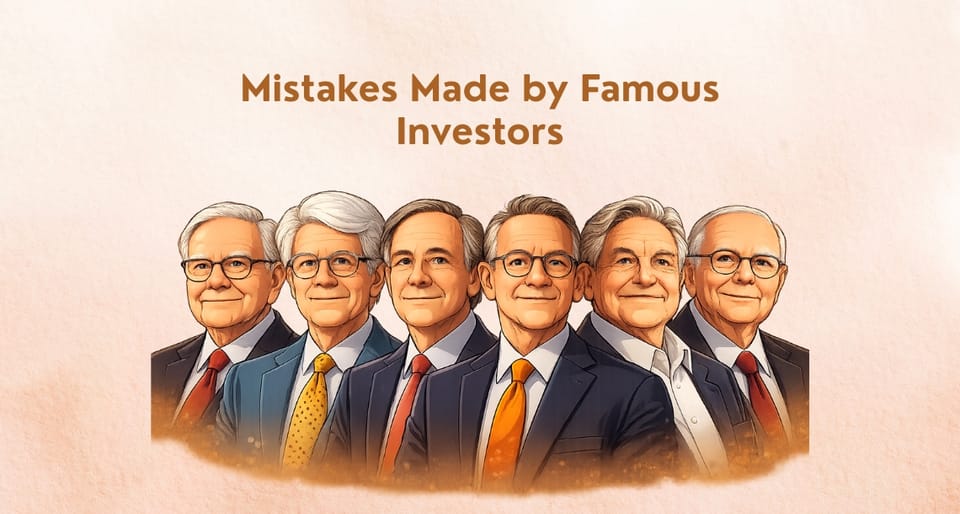
Most people worship famous investors as if they were superhuman calculators with perfect foresight. But markets don’t spare anyone—fame, intelligence, and experience included. The truth is, even the greatest investors made avoidable mistakes. The only difference is: they survived, analyzed, and adapted.
Studying their mistakes is like getting decades of experience without paying the tuition fee.
1. Warren Buffett – The “Circle of Competence” Violation
For decades, Buffett avoided technology stocks because he saw them as unpredictable. That caution protected him in the dot-com boom.
But there’s a flip side—he missed the early transformational phase of companies like Microsoft, Amazon, and Google.
He later admitted his reluctance to evolve delayed Berkshire’s exposure to the biggest wealth creation wave of our era. Apple entered his portfolio much later—and ironically became his largest winner.
Lesson:
Avoiding what you don’t understand is rational…
but refusing to learn something new can be expensive.
2. Peter Lynch – The “Too Many Ideas” Problem
Lynch believed in buying everything you understand.
He understood a lot.
Fidelity Magellan under his leadership became a monster performer—but holding 1,000+ stocks created portfolio complexity that even he later admitted was difficult to track.
Lesson:
Diversification is insurance.
Over-diversification becomes confusion.
3. Ray Dalio – The “Overconfidence Cycle”
Dalio’s early years ended in a brutal failure when he publicly predicted a US depression in 1982. The opposite happened — a roaring bull market.
He went from media sensation to broke, had to fire employees, and borrow money from his father.
Lesson:
In markets, being early is equal to being wrong.
Humility is not optional; it’s survival equipment.
4. Howard Marks – Underestimating Mania
Marks has written extensively about cycles and psychology. Yet even he admitted being surprised by the ferocity of the 2020–2021 liquidity mania, where assets from tech stocks to crypto skyrocketed with reckless velocity.
Even cycle experts forget that sentiment can remain irrational longer than logic can remain patient.
Lesson:
Knowing history doesn’t guarantee predicting behavior.
5. George Soros – Pain Tolerance Isn’t Infinite
Soros is famous for “breaking the Bank of England.”
But fewer people know his portfolio also endured heavy volatility and incorrect macro bets along the way.
He repeatedly changed convictions when reality shifted.
Lesson:
Flexibility is strength.
Conviction without flexibility becomes stubbornness.
6. Rakesh Jhunjhunwala – Narrative Over Fundamentals (Sometimes)
RJ had extraordinary skill in spotting long-term winners. But even he occasionally fell for narratives that looked powerful on paper but weak in execution—certain aviation bets being the classic example.
Aviation looked like an India growth story; structurally, it remained a brutal business.
Lesson:
Macro stories don’t always translate into micro profits.
7. Charlie Munger – The Opportunity Cost Error
Munger often criticized himself for holding cash too long when high-quality US companies kept compounding.
His problem wasn’t pessimism—it was valuation purism.
The market doesn’t reward perfection; it rewards action.
Lesson:
Being too tight on valuations can cost more than overpaying for great businesses.
Patterns Hidden in Their Mistakes
If you strip the names away, the underlying themes repeat:
✔ Overconfidence
✔ Narrative blindness
✔ Fear of change
✔ Excessive caution
✔ Excessive conviction
✔ Complexity overload
✔ Emotional attachment
✔ Macro arrogance
Markets don’t just punish stupidity.
They punish rigidity.
What Makes Great Investors “Great” Isn’t Perfection
The famous investors we admire are not error-free.
Their edge lies in how they respond:
- They analyze mistakes without ego
- They learn faster than others
- They size bets intelligently
- They survive long enough to recover
- They don’t defend their views at the cost of reality
In short:
They trade pride for probability.
The Most Dangerous Mistake: Not Admitting Mistakes
Retail investors often make errors that are smaller in scale but larger in denial:
- refusing to sell losers
- averaging down without logic
- confusing movement with progress
- turning trades into investments
- refusing to learn because “I know this”
What destroys wealth is not being wrong.
What destroys wealth is staying wrong.
The Market Doesn’t Allow Idols
Markets are the great equalizer.
You can be a billionaire, a genius, or a beginner — the rules don’t bend.
The best investors don’t avoid mistakes.
They minimize the cost of mistakes and maximize the learning.
If you copy their winners, you might make money.
If you study their losers, you’ll keep money.
FAQs – Mistakes & Markets
Q: Do only new investors make mistakes?
No. Mistakes scale with experience. Smart money makes smarter mistakes — but still mistakes.
Q: What’s the biggest mistake retail investors make?
Holding losers with conviction and selling winners too early — the opposite of rational behavior.
Q: Should we follow famous investors blindly?
Copying their ideas without copying their time horizon, conviction, research, and risk appetite is dangerous.
Q: Do famous investors admit mistakes openly?
The best ones do. Ego is expensive in markets.
Q: Can mistakes be eliminated?
No. Markets are probabilistic. The goal is not elimination — it’s optimization.




Member discussion