
How Compounding Works in Real Life — The Silent Engine of Wealth
Most people learn the term compounding in school, forget it in college, rediscover it in their late 20s, and regret not using it by their 40s. It’s one of the few concepts in finance that feels boring at the start and life-changing at the end.
Compounding isn’t about making money fast. It’s about making time do the heavy lifting for you. If investing were a race, compounding would be the runner who jogs slowly in the beginning and sprints like a maniac in the final lap.
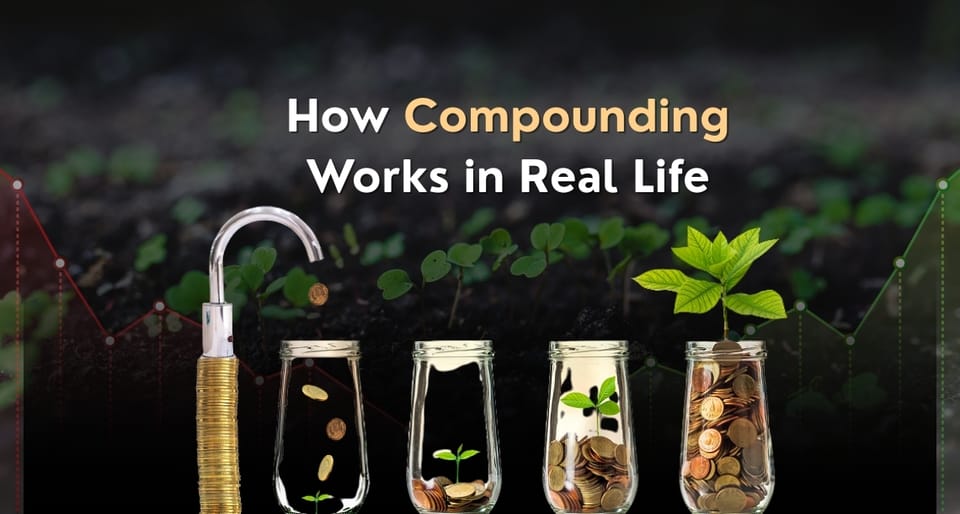
Compounding is the process where your returns start earning returns.
The “Slow–Slow–Slow–BOOM” Pattern
Compounding always misleads beginners because the first few years barely show results. The magic arrives embarrassingly late.
Example: ₹1 lakh compounding at 12% per year
- Year 1: ₹1,12,000
- Year 10: ₹3,10,000
- Year 20: ₹9,64,000
- Year 30: ₹29,96,000
- Year 40: ₹93,05,000
Nearly 70%+ of the final wealth shows up in the last decade.
This is why compounding is misunderstood — the final lap matters more than the first.
Time Beats Timing
Most people obsess about buying at the “right time.”
Compounding has a different rule:
Starting early > Starting perfectly
Example (12% CAGR, ₹10,000/month SIP):
| If you start at age | Invest until | Corpus at 60 |
|---|---|---|
| 25 | 60 | ₹3.52 crore |
| 30 | 60 | ₹1.94 crore |
| 35 | 60 | ₹1.06 crore |
Starting 10 years late costs ~₹2.46 crore.
And most people don’t even notice the loss until decades later.
The Behavior Angle (Where People Actually Fail)
Compounding doesn’t fail due to poor math.
It fails due to poor behavior:
- Lack of patience
- Lack of consistency
- Jumping between investments
- Selling at fear, buying at euphoric highs
- Treating investing like gambling
- Thinking in months instead of years
The ugly truth:
Markets reward discipline more than intelligence.
Beyond Money: Compounding in Real Life
Once you recognize the pattern, you start noticing it everywhere:
1. Skills
Reading 20 pages/day = 7,300 pages/year
In 5 years = 36,500 pages (~60+ books)
That’s enough to change careers.
2. Fitness
Consistency trumps intensity.
1 hour/week for 10 years beats 10 hours/week for 2 months.
3. Relationships
Trust compounds slowly and silently.
Small daily deposits → deep long-term bonds.
4. Business
Reputation compounds harder than revenue.
Companies win not by intense bursts of marketing but by years of credibility.
The Human Problem — The Curve Is Boring at the Start
We are wired for instant feedback:
- gym results in 2 weeks
- profits in 1 month
- career jumps in 1 year
Compounding plays a longer game:
- 5 years = feels like nothing
- 10 years = noticeable
- 20+ years = unstoppable
This mismatch kills most compounding journeys before they get a chance to bloom.
Interruptions Are the Enemy
Compounding is fragile.
Every withdrawal, every break, every “I’ll restart later” kills momentum.
The formula is simple:
Uninterrupted > Optimized
A mediocre plan executed for 30 years beats a brilliant plan executed for 3.
If compounding had a voice, it would say:
“Start now, stay consistent, don’t interrupt me, and don’t expect applause in year one.”
The tragedy is that people understand compounding at 40 and wish they started at 20. The victory goes to those who start at 20 even without fully understanding it.
FAQs
Q: Is compounding only for investing?
No. Skills, knowledge, brand value, health, and relationships also compound.
Q: What matters more — return or time?
Time. A lower return compounded longer beats a high return compounded briefly.
Q: How long do you need for compounding to show results?
Usually 10–20 years. The curve gets ridiculous after that.
Q: Should I wait for markets to fall before investing?
Data shows “time in market” beats “timing the market” in 90%+ scenarios.
Q: Is compounding risky?
Not compounding is riskier. Without compounding, your future depends entirely on savings, not growth.
Q: Can small amounts compound meaningfully?
Absolutely. Compounding doesn’t care about your ego, only your consistency.
Member discussion